Short answer
It’s a padded chair with a lever at the front. You hook your ankle behind a pad on that lever, put a weight on it, and straighten the knee. Honestly that’s about it. Physios like it for waking up a thigh that went lazy after an op or a fall, and for old, grumpy knees too. The weight, the angle, the number of reps? Ask your physio. Not the chair, and not us either.
Here’s something most people only find out after a knee operation. You try to tighten your thigh and nothing much happens. The big muscle at the front, the quadriceps, goes quiet surprisingly quickly once the knee is hurt, and it does not come back by itself.
A quadriceps chair is one of the oldest tools for getting it back. The load is a number you can write down, which physios love. We get asked about these chairs a lot, by clinic owners on the phone and by sons and daughters buying for a parent. Below is what we usually tell them, more or less in the order they ask.
Quick note on who’s talking. We’re Devyani Enterprise, and we build our own quadriceps exercise chair in our Ahmedabad workshop. So we’re not neutral. We’ll try to be fair anyway, including the bits where a chair isn’t the right buy.
Setting up a knee rehab corner?
Tell us roughly how many knee patients you see in a day and how much floor space you have. We'll reply with sizes and a price within one working day.
What is a quadriceps chair, exactly?
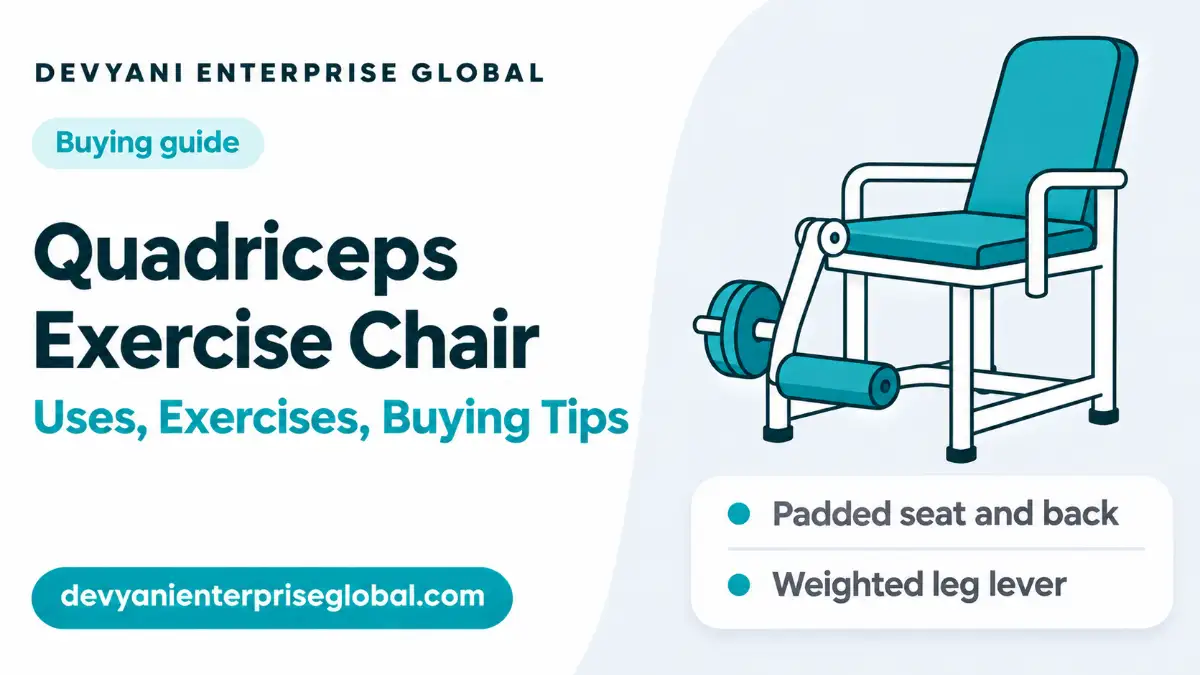
Picture an old school steel chair, but padded, seat and back both. Right at the front of the seat sits a hinge and a lever hangs off it. Near the bottom of the lever is a roller pad that sits on the front of the ankle. Weights go on the lever. You sit, get the knee level with that hinge, and kick up slowly till the leg’s straight (or till your physio yells stop, whichever comes first).
Names? Quadriceps table, quad bench, knee extension chair, we’ve heard all of them. Mostly it’s the same thing. Some sellers will even call a flat plank of wood a quadriceps board, so yes, check the photo first.
Why do clinics still keep one when there are fancier machines around? Mainly because it’s honest. Half a kilo more is half a kilo more. The patient feels it, the physio can note it down, and next week’s target is clear.
Who actually uses one
In our experience, most chairs end up being used for a handful of situations:
- Someone a few weeks out from knee ligament surgery, once the surgeon and physio have cleared it.
- A patient after knee replacement whose thigh has shrunk from weeks of protecting the joint.
- Grandparents who need two goes to get out of a low sofa.
- That one leg that came out of plaster looking skinnier than the other.
Who should stay off it for now? If the knee is swollen and hot, if nobody has looked at the injury yet, or if the surgeon has said no weights for the moment, then no. In those cases the chair waits. No shame in that.
Common exercises on a quadriceps exercise chair
Here’s what we tend to see physios doing on our chairs when we drop one off. Treat it as a rough sketch, nothing more; your own physio picks the exercise and the load.
| Exercise | What happens | Often used when | Keep an eye on |
|---|---|---|---|
| Full range straightening | Knee goes from bent to straight and back down | Later stages, general weakness | Heavy loads near straight can strain a healing knee |
| Short range work | Movement only between angles the physio sets | Earlier rehab, after surgery | Needs careful setup or a range limit |
| Static hold | Leg held still at one angle for a few seconds | Very weak or sore thighs | People forget to breathe, so remind them |
| Slow lowering | Lift normally, then lower slowly over a few seconds | Building control | Some muscle soreness the next day at first |
Setup tip, and we’ve watched plenty of setups: get the knee bang in line with the hinge. Slouch or scoot back and the pad rubs up and down the shin, and the whole thing feels wrong. Half a minute on setup saves a lot of moaning.
How starting weight is usually worked out
There’s no magic number printed on the chair. A lot of physios start by finding the heaviest weight a patient can lift cleanly ten times, and then build the session in steps below that. The point is that the steps are small and the patient doesn’t cheat by swinging the leg.
Made up example: Mrs Patel's first week
Mrs Patel is invented, but you’ve probably met someone like her. She’s 64, a couple of months after a knee replacement, and her physio in Maninagar wants to start her on the chair.
On day one she manages 4 kg ten times with good form. A fifth kilo and the leg starts to shake. So 4 kg is her ten rep limit for now.
Her physio has her do one set of ten at 2 kg, then ten at 3 kg, then ten at 4 kg. Slow up, slow down, a short rest in between.
A week later she breezes through the 4 kg set. The physio tests again, finds she can now do 5 kg, and the whole ladder shifts up by a bit.
Notice the jumps. One kilo, sometimes half. That’s why a chair with small plates beats a bag of sand from the market.
That example shows the general idea only. Your own numbers, sets and range must come from your physiotherapist or surgeon.
Safety first, especially after knee surgery
Knee straightening against a weight has a slightly mixed reputation after ligament surgery. These days most physios do use it, but carefully, and usually in a limited range.
The common approach goes something like this. Early on, light weights are kept to the bent part of the movement, roughly between 90 and 40 degrees of knee bend, and the lever is stopped before the leg gets close to straight. Heavy work through the full range comes much later, when the surgeon is happy with the healing. Exactly when depends on the operation and the person.
Pain at the front of the knee during the exercise is a signal to stop and tell the physio. Not to push through it.
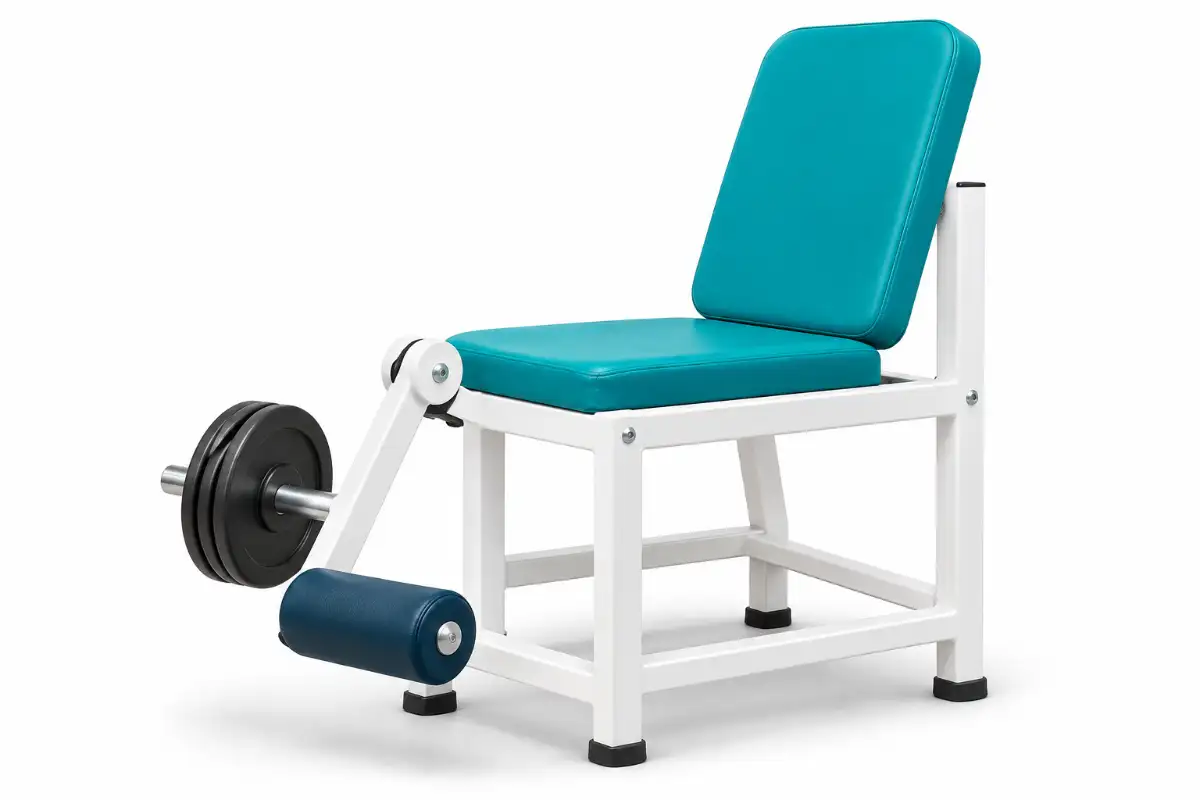
Ours is built along the same lines as the chair above: padded seat, padded back, a weighted leg lever and an adjustable range. Since we build it ourselves, we can also make a size to suit your room or your patients, which is handy for clinics with a lot of very tall or very short people.
Want a price on our quadriceps exercise chair?
Send us your city and any size needs on WhatsApp or through the quote form. Expect a reply within one working day, usually with a rough price in it.
What to check before you buy
Doesn’t matter who you buy from. Run through these before paying:
- Sit your shortest staff member on it, then your tallest. Did both get their knee to the hinge, or was someone perched on the edge like a bird on a wire?
- Ask how the range is limited. You want a reliable way to stop the lever at a set angle for post surgery patients.
- Weight steps. If the smallest plate is 2 kg, that’s too big a jump for a knee that just had surgery; we’d want half kilo or one kilo plates.
- Ankle pad: slide it up and down the lever, lock it, tug it. Short shins and long shins both need it to sit right.
- Plonk yourself down and kick hard, five or six times. Did it rock? Did it creep towards the door on your tiles? Then no.
- Squash the padding with your thumb. You want firm foam and a cover you can wipe, and no metal edge poking the back of the thigh.
- Spares, please ask. Pads wear thin in a busy place, and plates have a habit of walking off.
Mistakes and red flags we see
- Buying a gym leg extension machine for a rehab clinic. Even its lightest setting can be too much for a knee in the first weeks.
- A price that looks cheap until you find the weight plates, delivery and tax are all extra.
- Wobbly welds or a hinge with play in it on a brand new chair. That never gets better with use.
- Patients left alone on the chair with no written range or weight. Someone will always add more than they should.
Is a quadriceps chair worth it, or are ankle cuffs enough?
We get this one every week, honestly. Depends where it’s going.
A clinic with knee patients coming in all day will get a lot of use out of a chair, it’s quick to set and the patient sits supported. One person at home, though? Physiotherapy ankle weight cuffs often do the job for a fraction of the money, and they live in a drawer. Our ankle weight cuffs are made for exactly that kind of home use.
| Option | Works well for | Less good for |
|---|---|---|
| Quadriceps chair | Clinics, measured loading, range control | Small flats, very tight budgets |
| Ankle weight cuffs | Home exercise, travel, lower cost | Heavier loads, support and alignment |
| Gym leg extension | Fit people, late stage rehab | Weak or recently operated knees |
So if it’s one patient at home and space is tight, we’d honestly tell you to start with cuffs.
Building a knee and rehab corner around it
Most clinics we supply put it alongside a few other pieces of physiotherapy exercise equipments, so a patient can move from one station to the next without much walking around.
A common setup in a two room clinic looks like this. A pedo cycle for a gentle warm up, which is about the simplest pedo cycle physiotherapy equipment you can buy. Then the quadriceps chair for strength. A wooden plinth nearby for hands on work, parallel bars for walking practice, and a dumbbell wall rack set on the wall to keep weights off the floor.
Upper body patients need their own corner. A wall mounted shoulder wheel is the usual shoulder wheel physiotherapy equipment for frozen shoulder work, and an exercise wheel table covers wrists and forearms. Leave about a metre clear in front of the quad chair lever, so nobody kicks a cabinet halfway through a rep.
You can see everything we make on our products page, or browse by use on the physiotherapy equipment page.
Buying from a quadriceps exercise chair manufacturer
Buying direct from the people who weld and pad the thing has a few practical upsides. You can ask for a custom seat height or a wider frame. And spares are easier to sort out later.
As a quadriceps exercise chair manufacturer and physiotherapy gym equipment manufacturer, we deliver within Ahmedabad and Gandhinagar ourselves and ship across India. For buyers outside India, we prepare the export invoice and shipping papers along with the order.
A word on tax. GST on many medical devices was cut to 5% from 22 September 2025, but the rate depends on the HSN code of the exact item. Ask any supplier to show the HSN code and the GST rate on the quote, and check it with your accountant. More on how we work is on our why choose us page.
Frequently asked questions
What is a quadriceps exercise chair used for?
Getting the front thigh muscle strong again, mainly. You push the leg straight against some weight and every week or so your physio sneaks a bit more on. Lots of post op knees use it, and older folk with weak legs too.
Is it the same as a gym leg extension machine?
Kind of. Same kick, different crowd. Ours is meant for patients so the plates go up in small bits and the range can be cut short, whereas the gym one was designed with fit gym goers in mind and its lowest pin can be way too much for a sore knee.
Can I use it after ACL surgery?
Usually, but not on your own say so. Your surgeon and physio set the rules here, and early on that tends to mean light weight and stopping short of a straight leg. Please don’t guess on this one.
How much weight should I start with?
That’s your physio’s call, sorry. A lot of them test the most you can lift ten times without cheating and work below it. Go up in tiny steps.
Do I need a chair at home or are ankle cuffs fine?
Cuffs, for most homes. Cheaper and they don’t eat floor space. If the recovery is going to be long and you’ve got a spare corner, a chair can make sense. Your physio will have an opinion, ask them.
Can you make a custom size?
Yep. All our physio equipment gets built in our own Ahmedabad workshop, so a taller seat or wider frame is usually doable. Send us the sizes and we’ll tell you straight if we can.
How do I get a price?
Easiest is WhatsApp on +91 70414 61551, or the quote form if you prefer. Say which city it’s going to. You’ll hear from us inside one working day.
Get a quote for a quadriceps exercise chair
Is it for a clinic, a ward, or your dad's front room? Drop us a line with that and any odd sizes, and we'll get specs and a price back to you within one working day.