Short answer
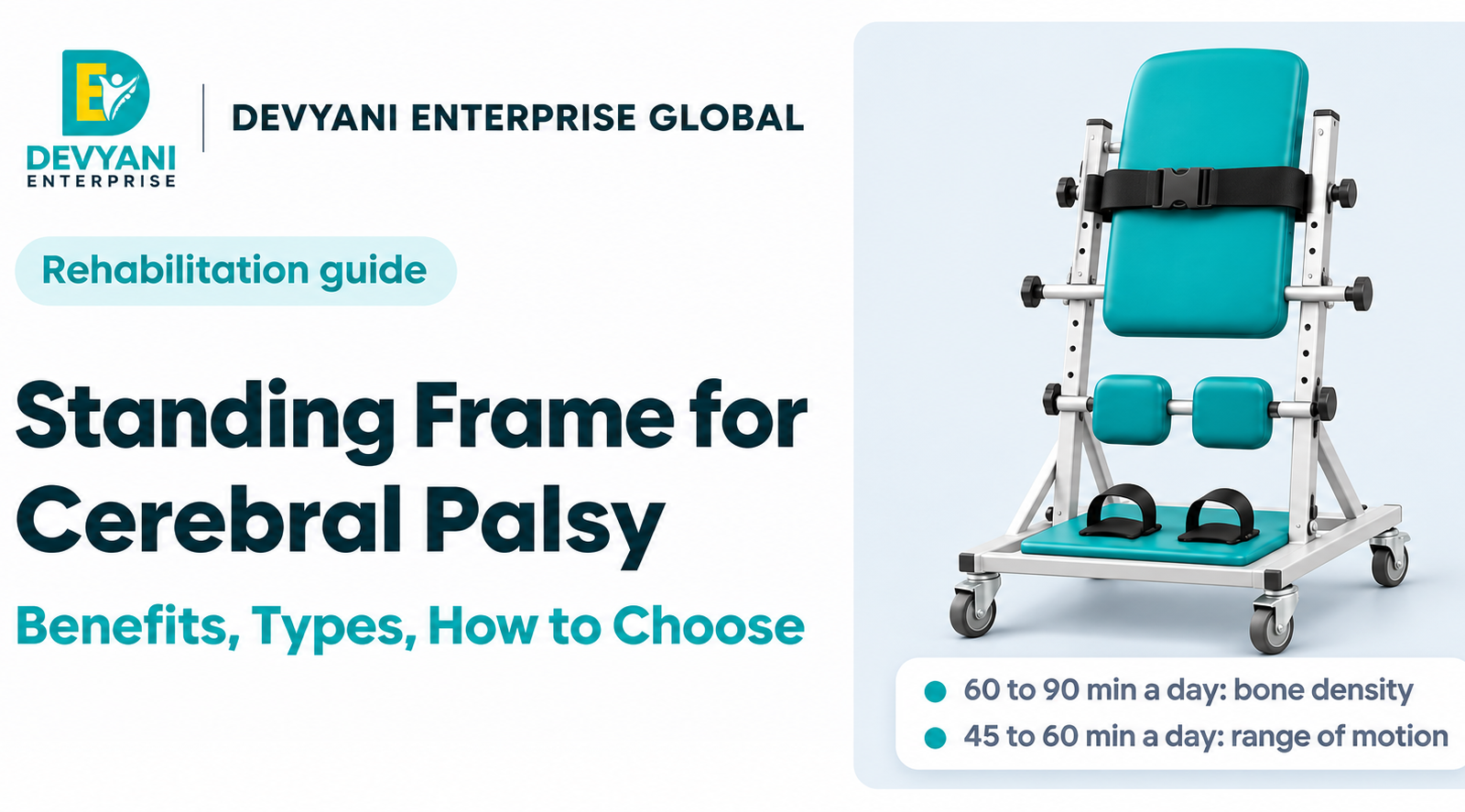
So what does it actually do? Put plainly, a standing frame for cerebral palsy is what holds your kid up on their feet when their muscles just can’t. Some of their weight goes down through the legs, which is half the point. Hands stay free for toys. And they get out of that chair for a while, which most kids are thrilled about. Which type, and for how long each day? Honestly, that’s for your child’s physio to decide, not us. Our job is building a frame that fits.
Most parents who ask us about frames have already been told by a therapist that standing time would help. Then they go looking and find prone, supine, upright, sit to stand, mobile… and a lot of very shiny photos. Bit overwhelming.
We make these frames in our Ahmedabad workshop, so we see the buying side up close. Parents measuring a four year old on the kitchen floor. This post is what we’d tell you over chai if you walked into the shop.
One thing before we start. We’re a maker, not a medical team. Everything here about standing time and posture is general, and your child’s physiotherapist knows your child. If they say something different from us, they win.
Got a child or a clinic in mind already?
Just message us the age and height, plus a line on how floppy or stiff your kid is. We usually come back the next working day with a frame idea and a price.
What is a standing frame, and which children use one?
Think of it as a padded steel frame that does the holding for the child. You get a pad at the back (or at the chest, depending on type), straps for the hips, knee pads and something flat for the feet. Buckle up and that’s your kid standing. Most have a tray on the front for snacks and toys.
Who uses one? Mostly children with cerebral palsy who can’t stand or walk on their own and spend much of the day sitting, in a wheelchair, a special chair or on someone’s lap. Some use a frame for a few years while they work on other skills. Others keep using one as teenagers and adults.
Why therapists want children standing?
Sitting for hours is hard on anybody. For a child who can’t change position by themselves, it’s harder. Your therapist will have their own reasons for suggesting a frame. Ask them which one tops the list for your kid, it’s a fair question.
Weight through the bones
Bones get stronger when they carry load. A child who never stands doesn’t give their leg bones much of that. Standing in a frame is one of the few ways to do it.
Hips, and a long slow stretch
In some children with CP the hip can slowly drift out of its socket. Many physios set the frame so the legs stand slightly apart, which may help. At the same time, tight muscles at the back of the thighs, the hips and the calves get stretched for as long as the child is up. Your physio will tell you the angle and how far apart. Please don’t guess this one.
The things families notice
Parents tell us about easier toilet days, deeper breathing, and a child who just seems brighter after standing. Picture a little girl at the kitchen counter, eye to eye with her big brother for the first time. Nobody needs a study to see what that moment does for her.
Types of frame: prone, supine, upright and the rest
Best type? We get that question a lot and there isn’t one. Mostly it’s about head and trunk control. Then whether the hips or knees stay bent, and frankly, how you’ll get your kid in and out on a busy morning.
| Type | How it holds the child | Often suits | Watch for |
|---|---|---|---|
| Prone | Support at the front, leaning slightly forward | Children with some head control who need to work on it | Tiring if head control is still weak |
| Supine | Child lies on a back board that tilts up slowly | Children with poor head control or more medical needs | Less work for the trunk muscles |
| Upright | Straight up, with back, hip, knee and foot support | Children with fair trunk control | Hard to use if hips or knees can’t straighten |
| Sit to stand | Moves the child from sitting to standing | Children who transfer from a chair, small homes | More moving parts and locks to check |
| Mobile | Wheels the child can push | Children ready to move around on their own | Needs space and close watching |
Where do ours fit? Our CP standing frame is an upright frame in powder-coated mild steel, with a padded back board, three adjustable straps and a padded footplate. It’s the one most parents end up asking about for home use.
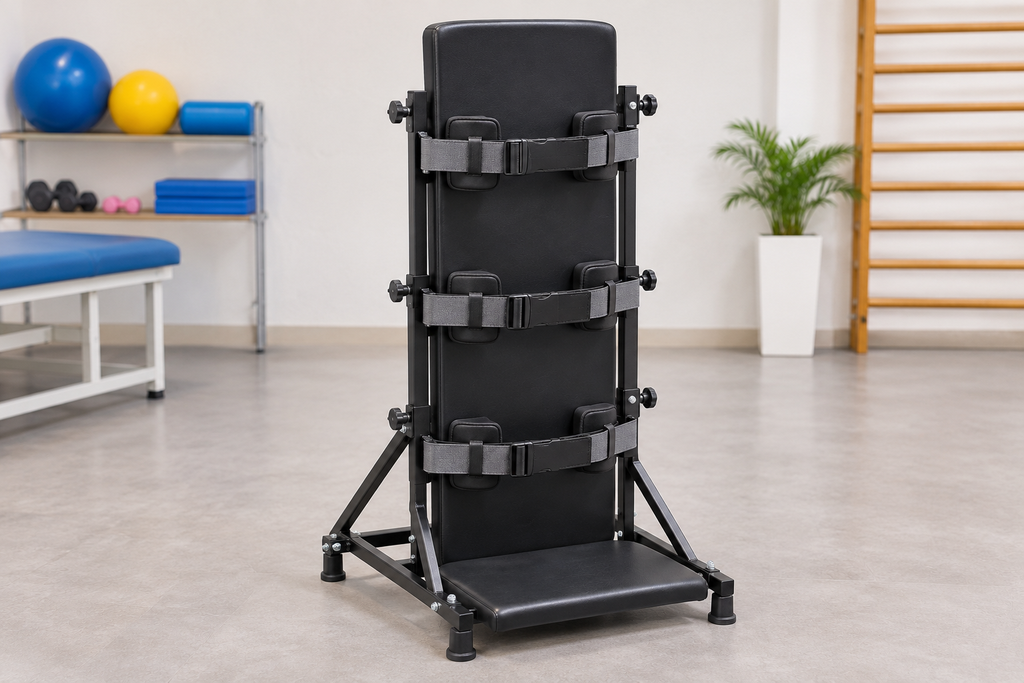
For clinics we also make a mobile frame with chest and knee supports and castors that lock. One frame, wheeled between rooms.
How to choose the right standing frame?
- Head and trunk control. This decides prone, supine or upright more than anything else does.
- Size now, plus room to grow. Kids shoot up. Ask how far the knee pads, chest support and footplate move.
- Knees and feet that adjust separately. Lots of children are tighter on one side, or have one leg a bit shorter.
- A footplate that tilts. Tight calves won’t sit flat, and most children stand in their ankle splints anyway.
- Firm straps, wipeable padding. Tug a strap hard. If it slips, it’ll slip with your child in it too.
- Castors that lock properly. A frame that creeps when the child leans? Nobody will trust it.
- A tray. Children stand longer when there’s something to do on it.
- Getting in and out. Who lifts, and how often? Picture the morning rush before you decide.
Worked example (made up): measuring before you order
Let’s say Meera lives in a second floor flat in Vatva with her son Kabir. He’s five, and she’s not real, but she’s a lot like the mums who message us. Kabir’s physio has said an upright frame with a tray.
Step one, she measures him lying down because he can’t stand: heel to top of head, chest width at the armpits, hip width, and heel to the back of the knee. She sends us the numbers and a photo on WhatsApp.
Step two, the flat. Her bedroom door measures 72 cm, so the frame base has to pass through that, or stay in the hall. Ours can be built narrower, so we’d check that before cutting any steel.
Step three, growth. We’d set the pads in the lower half of their range today, so there’s travel left for the next growth spurt instead of buying again in a year.
Done. Meera spent maybe ten minutes with a tape, and it saved her a week of back and forth with us.
Buying for a CP school or therapy centre?
We build to the sizes you need, including odd ones. Send the age range and number of children and we’ll work out sizes and a price.
How long should a child stand?
We get asked this every week. And we always give the same answer: ask the physio. Daily time depends on what they’re working on, how the hips look, and how your child copes.
The practical side, we can help with. Start small and build up slowly, as the physio suggests. Two shorter sessions often go better than one long one. And keep an eye on the skin around the knees and feet each time the child comes out.
Boredom is the real enemy, to be honest. A child with crayons, a tablet with a cartoon, or lunch on the tray will happily stand a lot longer than one staring at a wall.
Setting up at home, school or clinic
At home it’s one child, so the fit matters most. Check doorways and lift sizes before you order, and get castors if the frame has to move between rooms.
A school or child development centre is a different puzzle. Several kids, all sizes, sharing a couple of frames. You’ll want a wide adjustment range or two frame sizes, and covers you can wipe down quickly between children.
In a clinic, the frame sits next to other kit. A physiotherapy positioning wedge helps with tummy time and head lifting. A bolster roll for physiotherapy sessions is great for sitting balance and rolling work. Kids love a scooter board, and a two-step foot stool makes it easier for staff to reach a child on a high plinth.
Later, when a child starts practising steps, parallel bars and a forearm support walker usually come next. You can see all our physiotherapy products in one place, or browse the physiotherapy equipment range by type.
Buying mistakes and red flags
When you speak to any rehab standing frame supplier, ours included, keep these in mind:
- Buying on photos alone. Ask for the measurements and how far each pad adjusts.
- Foam so thin you can feel the steel through it. Press hard with your thumb.
- Castors with no locks, or locks that don’t really hold.
- Straps that give way when you yank them. Try it, the seller won’t mind (and if they do, that tells you something).
- Rough welds. We’d honestly feel every joint with a finger, it takes a minute.
- Nobody to call later. Straps wear out and kids grow. You’ll want spare parts and changes, quickly.
- Ignoring the tax line. GST on many medical devices was cut to 5% from 22 September 2025, but it depends on the HSN code, so check it on the quote.
When not to stand, and is a frame worth it?
There are times to pause. A fresh fracture, a weight limit after surgery, or pain while standing all mean you stop and call the physio. Same if the child goes pale or dizzy as the frame comes up. Don’t push through any of that.
And is it worth buying one? Not always, and we’d rather say so. Say your kid stands only at the therapy centre twice a week and the centre has a frame already. Then hold off on a home one for now and check with the physio. If standing at home every day is the plan though? Then yes. A frame that fits and actually gets used is about the best money you’ll spend on a kit.
What about imported frames? Some are lovely, and for complicated cases with fixed joints or powered sit to stand needs, they may earn their price. For most families and centres, though, the cost after freight and customs duty is hard to justify. A locally made frame with good padding, the right adjustments and a maker who answers the phone covers most children. That’s partly why clinics look for a rehabilitation equipment supplier India side, close enough to fix a strap next week, not next quarter. You can read more on how we work.
Looking after the frame
Nobody’s favourite job, we know. Soapy water and a cloth on the pads after use is plenty. Once a week we’d tug the straps and test the castor locks, and once a month somebody in the house should go round the bolts with a spanner. Growing child? Move the knee pads and chest support every few months, or whenever the physio says. Need a spare strap or a new pad? Just get in touch and we’ll sort it out.
This post is general information, not medical advice. The type of frame, the angle and the daily standing time are for your child’s physiotherapist to decide.
Frequently asked questions
What is a standing frame used for in cerebral palsy?
It holds a child upright when they can’t stand by themselves. That puts some weight through the legs and hips, gives tight muscles a stretch, and gets them out of sitting for a while. Parents often say their kid is happier for it too.
At what age can a child start using a standing frame?
There isn’t one age for everyone. Some start as toddlers, around when other babies pull themselves up, and others start later. Your child’s physio will say when, and which type.
How long should my child stand in the frame each day?
Your physio sets this, based on the goal and how your child copes. Lots of kids hate one long go. Splitting it into a morning bit and an evening bit works for loads of families.
What’s the difference between a prone and a supine frame?
Prone means tummy side. The kid leans forward a little onto a front pad and has to hold their own head up, so it’s harder work. Supine is the back side: they lie on a board that tips up slowly. Gentler, if head control is still wobbly.
Will a standing frame help my child walk?
Not by itself, sadly. Think of it as getting the legs used to weight and keeping muscles from tightening up. If walking is a goal at all, that comes later, with bars, a walker and plenty of sweat in therapy.
Can you make a frame in a custom size?
Yes. We build in our own workshop, so we can change the height, width or pad positions. Send measurements and a photo, and we’ll tell you what’s doable.
Do you deliver outside Ahmedabad?
We deliver ourselves in Ahmedabad and Gandhinagar, and ship across India and abroad. For export orders we prepare the invoice and shipping papers. Message us on WhatsApp or through our contact page.
Let’s find the right frame for your child or centre
Share the age, height and support needs, or how many children you have. We’ll reply within one working day with a suggestion and a quote.